Life inside an army ant swarm
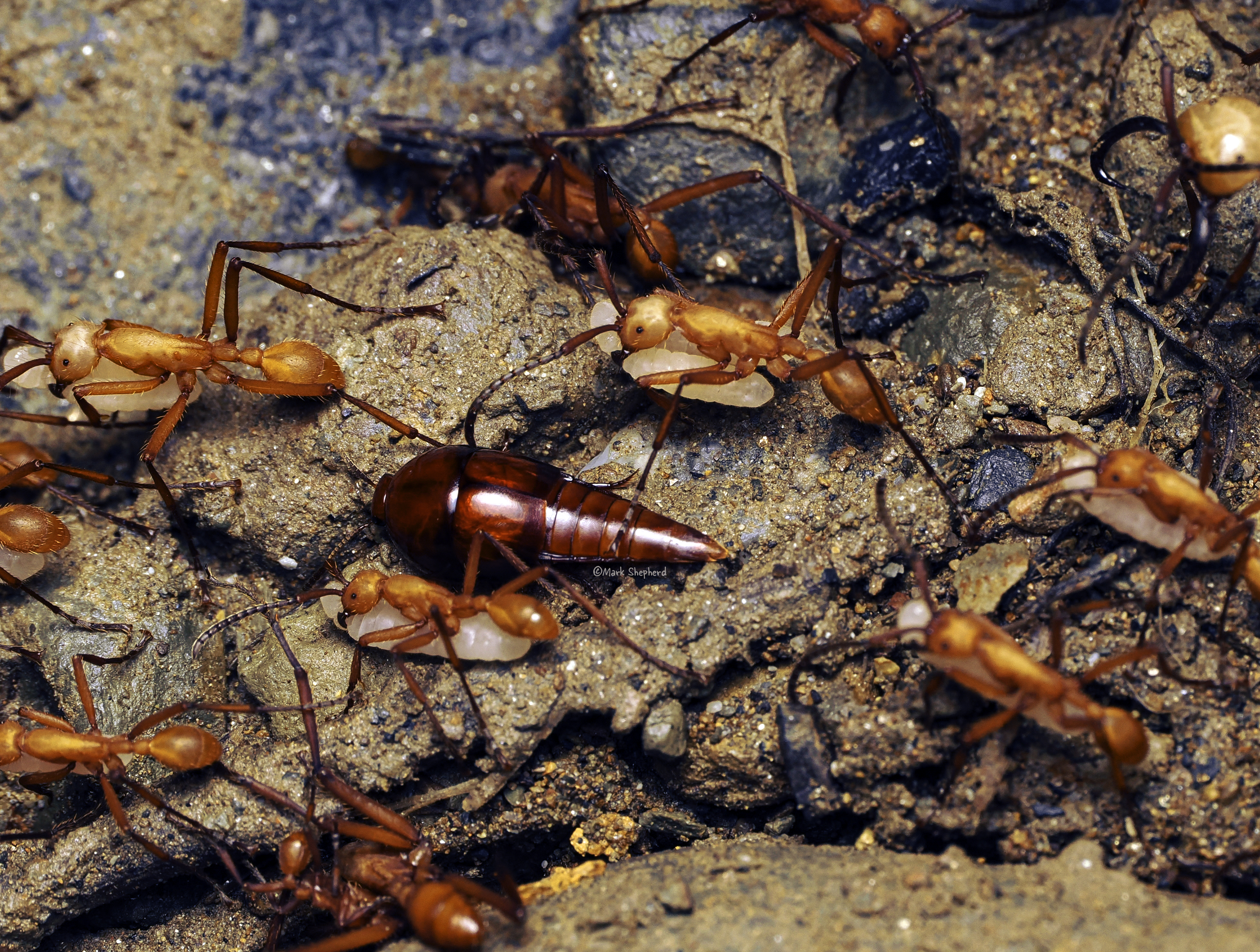
In the tropical forests of Central and South America, the army ant Eciton hamatum moves in vast, coordinated swarms. As these raiding columns spread across the forest floor, they rapidly dismantle the leaf litter community. As a result, few organisms can remain in their path. Most animals flee immediately. However, a small and specialized group does the opposite. Instead of escaping, they enter the swarm itself.
These organisms are known as inquilines. Rather than avoiding danger, they depend on it.
What it means to be an inquiline
Inquilines do not simply follow army ants at a distance. Instead, they live inside the ants’ social system. They move through the bivouac, travel with the colony, and interact directly with workers. Because army ants attack unfamiliar organisms within seconds, inquilines must remain undetected at all times.
In the case of Eciton hamatum, this lifestyle reaches an extreme. Consequently, colonies host dozens of associated species, many of which evolved exclusively alongside these ants.
A moving home with constant opportunity
Unlike ants that build permanent nests, Eciton hamatum forms temporary shelters called bivouacs. These structures consist entirely of interlocked worker bodies. As the colony migrates, the bivouac dissolves and reforms elsewhere. In this way, the ants create a constantly moving home.
For inquilines, this behavior offers major advantages. First, it provides continuous protection from predators. Second, it allows effortless transport across the forest floor. As a result, inquilines gain access to new environments without exposing themselves to external threats.

Feeding alongside a superpredator
At the same time, army ant raids generate enormous feeding opportunities. As the swarm advances, it flushes insects, spiders, and other small animals from hiding. Many of these prey items suffer injury or exhaustion. Therefore, inquilines exploit the resulting chaos.
Some species follow the raiding columns and feed on injured prey. Others steal food directly from ants during moments of confusion. Meanwhile, many remain inside the bivouac, where they feed on waste, debris, or dead ants. In every case, the ants’ hunting success supports a secondary community of consumers.
Masters of mimicry
Among all inquilines associated with Eciton hamatum, rove beetles stand out as the most specialized. These beetles closely resemble ants in body shape and movement. They walk like ants, pause like ants, and navigate ant trails with precision. Most importantly, they mimic ant chemistry.
Army ants rely on scent to recognize nestmates. Each colony carries a unique chemical signature on its body surface. Therefore, inquilines must match this signal precisely. By copying these chemicals, rove beetles pass as members of the colony. As a result, ants tolerate their presence rather than attack them.
Living under constant threat
Even with these adaptations, life among army ants remains dangerous. A slight error in scent or behavior can trigger immediate aggression. For this reason, inquilines must constantly maintain their disguise. Some release appeasement chemicals that reduce ant hostility during contact. Others rely on speed and agility to escape detection.
Over time, this pressure drives rapid evolution. Ants improve their ability to detect intruders. In response, inquilines refine their mimicry and deception. Thus, both sides remain locked in a continuous evolutionary struggle.
Costs, tolerance, and coexistence
Although inquilines exploit army ant societies, the overall cost to the colony often remains low. Eciton hamatum colonies contain hundreds of thousands of workers. Policing every intruder would require significant energy. Therefore, tolerance can be more efficient than constant defense.
In some cases, inquilines may even provide indirect benefits by removing waste within the bivouac. Consequently, these relationships rarely fit simple categories such as parasitism or mutualism. Instead, they reflect a balance shaped by efficiency and survival.
A hidden ecosystem within the swarm
Ultimately, an Eciton hamatum colony functions as more than a group of ants. It operates as a mobile ecosystem. Inquilines reveal how complex societies attract exploitation and how adaptation makes coexistence possible. Within the rushing swarm exists a quieter world shaped by precision, deception, and constant risk.


Related Posts
Are Insect Populations Declining?
Biodiversity Increases While Species Losses Continue to Climb